
Dave Clarke
Senior Product Manager, SquaredUp
Sign up for a free account and get visibility in minutes
Ditch your static, outdated dashboards! Our smart dashboards collate and show you the data that matters.
Dashboards are supposed to answer questions, not create more of them. But investigations don't stop at a single view. The moment you want to understand one specific thing in detail like a failing VM, a degraded service, a slow pipeline, dashboards start to break down. You end up either building yet another dashboard or searching through many different ones.
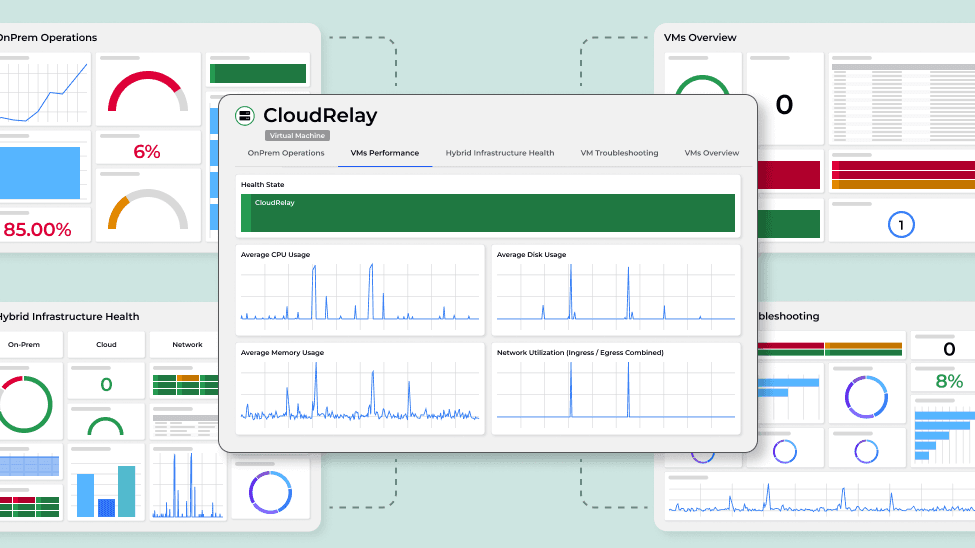
SquaredUp's Perspectives changes this. Drilldown to any object, and every relevant dashboard appears, pre-filtered to that specific object so you have all the information you need at a glance!

Here's what we hear all the time from people who build dashboards: users keep coming back with the same questions. "What’s causing this?" "why is performance degraded?" You build a great dashboard and document everything. And still, they hit a wall when they want to dig deeper.
This gives you two options:
Dashboard sprawl: Build dozens of dashboards trying to anticipate every question. Now finding the right dashboard becomes its own problem.
Accept the limits: Live with static views that answer some questions, but users keep coming back for more context.
With Perspectives, there's a third option.
Traditional dashboarding tools treat exploration as an add-on. You build your dashboard, then if you remember, you add some filters. Maybe you set up drill-downs. It's always an afterthought.
The problem is that this approach assumes people know what they're looking for before they start looking. But that's not how investigation works. You start with a question, find part of an answer, which leads to another question, which requires looking at the data from a different angle. Static dashboards force you to predict this entire chain of inquiry before you build anything.
We built Perspectives because we think exploration shouldn't be an afterthought. It should be the default. When someone wants to understand what's happening with a specific server, or customer, or application, the relevant context should just be there. Not because someone remembered to build it in, but because it's built into how Perspectives works.
When users want to go deeper, the path should already exist. That's what Perspectives does.
Traditional dashboards make you start with the dashboard and filter down. Perspectives flips this- you start with the object you care about, and the relevant dashboards come to you.
Click on any object in SquaredUp - a server, an application, a customer segment, whatever. Perspectives automatically discovers every relevant dashboard across your organization- dashboards built by different teams, dashboards you might not even know exist, and brings them all into one view,
Plus, with over 100 native data sources and prebuilt perspectives created by experts, you get detailed, relevant insights right out of the box.
See it in action:
If you’re already familiar with dashboard variables, skip to 3:22 for the juicy demo of perspectives!
Dashboard sprawl happens when dashboards are scattered across your organization. Different teams build what they need, store them in different folders or spaces, and you have no idea what exists or where to find it. Here's what that actually looks like.
One of your VMs is down. You open your monitoring tool, then your cloud console, then your storage dashboard, then your network monitoring platform. Ten tabs deep, you're trying to figure out if it's a memory issue, a storage bottleneck, or something else entirely.
Each tool shows you a piece of the puzzle, but you're the one manually connecting the dots. And you might not even know that Bob from Security just built a dashboard last week with exactly the information you need right now. You're left hoping you're not missing something important.
With Perspectives, you click on that VM anywhere in SquaredUp and instantly see everything relevant: cluster metrics, SAN availability, hypervisor performance, memory spikes, recent alerts, APM trends - even Bob's security dashboard you didn't know existed. All filtered to that specific VM. The issue becomes obvious in seconds.
This is how dashboarding should work. Dashboards shouldn't force you to stop and ask, "Where do I look next?" That's what Perspectives changes. When exploration is built in from the start, dashboard sprawl stops being inevitable. Users stop hitting walls. And you stop fielding the same questions over and over.
Want to talk? We'd love to hear what your dashboard experience looks like today. What's working? What's driving you crazy? Reach out and let's chat. After all, it's all about perspective 😉
Ready to see Perspectives in action? You can experience it right now in SquaredUp. No more static views, no more dead ends. Just dynamic data exploration built for how you think.
Senior Product Manager, SquaredUp